
My preparation to become a dive professional
When I decided to leave Germany to become a dive instructor, I talked a lot with my future instructor, did online research and calculated how much money I needed to save and how I would be able to achieve this goal. The plan was to go back to Koh Lipe in Thailand to the shop I did my Open Water course with and continue my courses there. The plan was also to finish the Divemaster course there before the high season starts to be able to work as a Divemaster during high season. Well, it didn’t worked that way.
I was told that a divemaster earns around $500 per month during the high season in Koh Lipe, and an instructor earns an average of $1,000 to $2,000 per month.
This was my calculation in 2017, how much I needed to save in advance to be able to do my training up to Divemaster and work in the high season on Koh Lipe:

Well, if we convert 500$ into THB, that’s about 18.000 THB today.
A bungalow in high season back then was 12-15.000 THB per month.
That leaves only 3-5.000 THB to live on.
There isn’t work every day, so we have to put something aside.
So let’s calculate with 4.000 THB to live on.
We’re lucky there, because no scooter is needed on Koh Lipe.
Have you ever tried to go on vacation for 4 weeks with 4,000THB? Surprising.
Real numbers:
I ended up not finishing my DMT on Koh Lipe. So, the flight to Bali was not included in the calculation, nor were the fun dives I did there, nor was the two-week holiday.
At the end, I´ve finished my DMT in Amed, Bali, and went back to Thailand to work there.
I worked as a freelance divemaster on Koh Lanta in the 2017/2018 season.
Payment varied depending on the shop where I worked. It varied from 700THB for 1 Fun Diver to 1,000THB for 2-4 Fun Divers.
Refreshers were paid between 900 THB and 1,250 THB per person.
Back then, rooms were still available for 6,000-7,000 THB per month, and scooters for 2,500 THB per month.
A commission of between 10% and 25% was paid for referring divers to shops.
This varied depending on whether you also dived with the guests.
So, I had to calculate the best way to get paid.
If I had the chance, the best earnings came from referring someone and working with another shop on the same day.
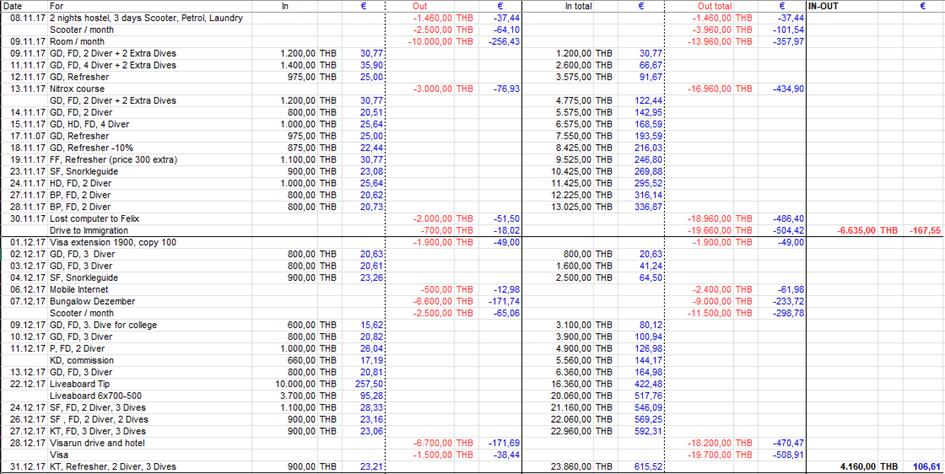
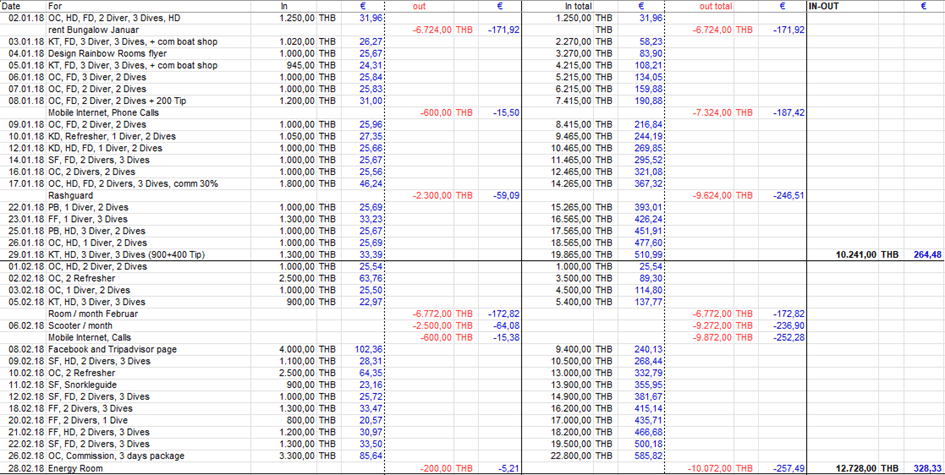
This is my Excel sheet with the in and out from 2017/2018. As you can see here, the highest income I had during this time was €350 for the month:
Can you make a living from it? Difficult.
Would I do it again for the experience? Yes, definitely.
Well, what changes in pay once you become an instructor?
I got a job straight after my instructor course in Bali, Amed.
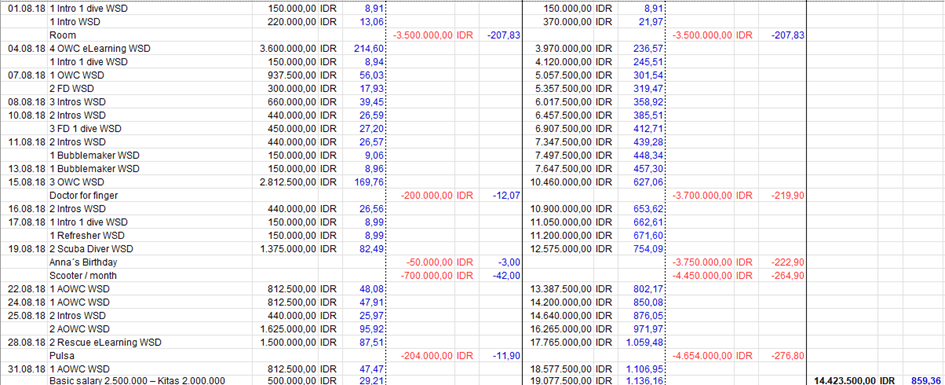
The cost of a house here was and still is 3,500,000 IDR per month. The cost of a scooter is 700,000 IDR per month (today it’s more like 900,000 IDR, if you´re lucky).
I had a permanent job there with a basic salary. Often, there is no basic salary, and instructors are only paid on a commission basis.
Half of the work permit costs were deducted from my basic salary of 2,500,000 IDR over the 6-month employment period.
In August, we were extremely busy and sometimes completed three dives a day.
That month, I had my highest income to date, with around € 1,200, of which €850 was left over.
Now you also have to take into account that I was single and therefore paid for the accommodation alone. If you share it, of course, that makes a difference.
Fast forward to 2019-2020, when I was working in the Maldives.
In the first year, a basic income of $650 was paid, plus commission, plus service charge.
Accommodation and food are usually included here. Also, the flights to and from the Maldives.
The prices in the 5* resort where I was employed were comparatively high, which had a positive effect on the commission and service charge.
Nevertheless, you still have a few expenses here too.
The bottom line here is that I had between $800 – $1,600 at the end of the month.
If you stay longer in the Maldives, your basic salary increases annually.
In 2023, I returned to Bali and took over management of my old dive shop.
My calculation was that I had to earn at least 10,000,000 IDR per month to live decently. So, I negotiated a basic salary of 8,000,000 IDR, and the plan was that I would earn the rest through course commissions.
Unfortunately, that didn’t quite work out because I wasn’t able to teach as much as I had hoped.
However, as I had paid for my house and scooter in advance, thanks to the money I had saved during the pandemic in Germany, I was able to live quite comfortably.
How to calculate your income as an instructor?
Have you ever noticed that most courses have 4 students to one instructor (or more)?
Have you ever asked yourself why?
This division is called the ratio.
With a ratio of 4:1, the group is small enough to be well-controlled, yet large enough for the instructor to be relatively well-paid.
1:1 or 2:1 would be ideal, but the shop would need to have a large number of instructors and compensate them. And the instructor may not earn a sufficient amount.
There are islands where courses are offered at very low prices, and instructors receive only a 15% commission per student. This means that you can only make a reasonably good income from the masses of students.
Let’s do another small calculation example:
An Open Water course costs approximately 10,000 THB. Let’s deduct, say, 1,000 THB for certification fees.
The instructor’s commission percentage is therefore calculated from the remaining 9,000 THB.
If the instructor only receives 15% commission per student, the salary is calculated as follows:
9,000 THB * 0,15 = 1,350 THB / 3 days = 450 THB / day
If you take my overview from my time as a divemaster as a basis, you can see that this instructor in this scenario earned less per day for training a diver than a divemaster for a simpler job.
Now let’s increase the number of students:
1,350 THB * 2 students = 2,700 THB / 3 days = 900 THB / day
(about the same as I earned as a DM with 2 fun dives)
1,350 THB * 4 students = 5,400 THB / 3 days = 1,800 THB / day
1,350 THB * 6 students = 8,100 THB / 3 days = 2,700THB / day
Now, ask yourself whether this makes sense for the students’ good education.
If a shop pays 25% commission instead of 15%, it looks like this:
9,000 THB * 0,25 = 2,250 THB / 3 days = 750 THB / day
2,250 THB * 2 students = 4,500 THB / 3 days = 1,500 THB / day
2,250 THB * 4 students = 9,000 THB / 3 days = 3,000 THB / day
Perhaps it is now clearer why I made the statement in another article that, in my opinion, the diving industry is too cheap.
What do I need to consider when applying for a job?
If you want to work as a freelancer somewhere, you should know which shops pay what.
I am a nerd. I have Excel sheets for everything.
During my days as a DM freelancer in Koh Lanta, I was surprised to find that I was apparently the only person who had written down these numbers. Most of the other freelancers just went with the flow and thought their shop of choice paid best.
If you apply for a fixed position, you should ask about whether there will be a basic salary and what is expected of you in return. And of course, how much commission you´ll get paid per course or work you´ll do.
Additionally, you should know the selling prices to determine if the payment aligns with the work you´ve done.
Furthermore, dive shops calculate the commission in different ways. There are no standards.
Usually it should be something like this:
Selling price * commission% = payment
However, some shops prefer to reduce the course fees (the amount they need to pay to the organisation for the course materials and certification) before calculating the commission payment.
Additionally, there are shops that not only reduce the course fees initially but also offer a discount. This is, in my eyes, the worst possible way, because it´s up to the shop to give a discount. The instructor is doing the same job but gets paid less. This procedure is, in my eyes, very unfair to the instructor, and you should consider if you want to work for these places.
How much income is possible?
Let´s do some fictional but realistic calculations.
Koh Lanta 2024 as an example:
A room could be found for 10,000 THB/month, and a scooter could be rented for 3,000 THB/month.
Therefore, you would already have 13,000 THB in fixed costs per month, excluding food and drinks.
Now, let´s calculate that in December (peak season), you were busy almost every day with only Open Water courses. So, you would have been able to fit around 9-10 courses into the month.
Let´s calculate with the best case of 4:1 in each course.
With an average course cost of 12,500 THB per student and 4 students in a course, that translates to a selling price of 50,000 THB.
In the best case, when the commission is calculated from the selling price without deduction, this would be 12,500 THB for the instructor.
So, with 9-10 courses in a month, that would be a salary of 112,500-125,000 THB (3.000-3.350€) per month.
Jezz, if I were able to earn this much, I would be more than happy.
Most likely we are talking about 30-50.000THB per month, cause it´s not always a 4 pack, it´s not always an open water course, and we also need off days to recover.
So, if you make 50,000 THB (around 1.300 €) per month and you need to pay 13,000 THB in fixed costs, you´ll have 37,000 THB per month. Now, you still need to live, eat, drink, put petrol in your scooter, and so on.
As a Divemaster, you can maybe make 30,000 THB/month (around 800€) with the same fixed costs.
What do I need to keep in mind?
What pays the best per day.
Let´s take Koh Lanta in 2024 again as an example.
A DSD/Try Scuba was, on average, around 4,000 THB per person.
So, with 2 students and 1,250THB commission per student, the instructor would have made 2,500THB per day.
With an Open Water Course 4-pack as exemplified above, it would have been 4,166THB per day.
With an Open Water Course 2-pack as exemplified above, it would have been 2,083THB per day.
Therefore, the daily salary with 2 DSD/Try divers compared to an Open Water Course 2:1 would be more beneficial. Less work and better salary.
If you work for a shop that offers only a 2:1 or even 1:1 ratio, you would need to ask yourself if this is a significantly better ratio worth your work. I would only do that with a basic salary or if the prices are that high that I have the same or more salary at the end.
Especially when you want to work as a freelancer, you need to keep these numbers in mind.
Besides the income: Expenses
Visa costs:
Keep in mind that we are working as foreigners in foreign countries (if you don´t work as a dive instructor on your weekends in your home country).
You need a suitable visa/work permit, or you will live with the fear of immigration.
Visa costs should not be overlooked when planning your trips.
How long can you stay?
How much do you need to invest in the visa?
Are you fortunate enough to have a job where the shop covers the cost of your visa?
Insurance costs:
You will also need a dive insurance. My preference here is Divers Alert Network (DAN).
Do you want to pay for travel insurance on top?
You also need to calculate these costs when making money. This will also be the cost you will need to generate.
Especially as an instructor, you need to pay the annual fees for the dive organisation you want to work for. Read more here.
Fix costs at home:
If you still have an apartment, house, or car at home, you also need to consider how to cover these costs.
SIM card/telephone/mobile internet:
Typically, the most affordable option is a local SIM card. However, you may prefer to use your home provider with roaming data.
Food etc:
Take a look at the local living costs, including expenses for food, drinks, etc., and calculate these as well.
Flight costs:
Also, keep in mind that you may need to change locations regularly and save up these flight costs.
Conclusion
“So, why the heck are we doing this job?” you ask. 🙂
A good instructor doesn’t do this job for the money/to get rich; we do it because we love our job and enjoy the freedom to travel.
For me personally:
I loved teaching already, and now I can do it with the most fun I can imagine. The safety of my students is always a priority, but I prefer to teach with fun. Laughter is for me the best reminder tool.
Additionally, I enjoy working with individuals who are afraid or who want to overcome fear/trauma.
But basically, just being there and holding their hand while they do the heavy work of extending their comfort zone and reducing their fear zone is the reward; the reward when they start to feel comfortable and enjoy is unbeatable.
Compared to Germany, I also don´t work fewer hours, but the stress level is lower, which makes it less demanding. Money is not everything. Enjoying what I do and being able to live my life counters this part.
However, having a second income from a part-time job is not unusual and would also be a good idea for you. Especially since the rent increases each year. I personally blame this on the digital nomads who just pay way over the usual local prices. But let´s keep this topic for another time.
 divepromentor.com
Leave a comment